
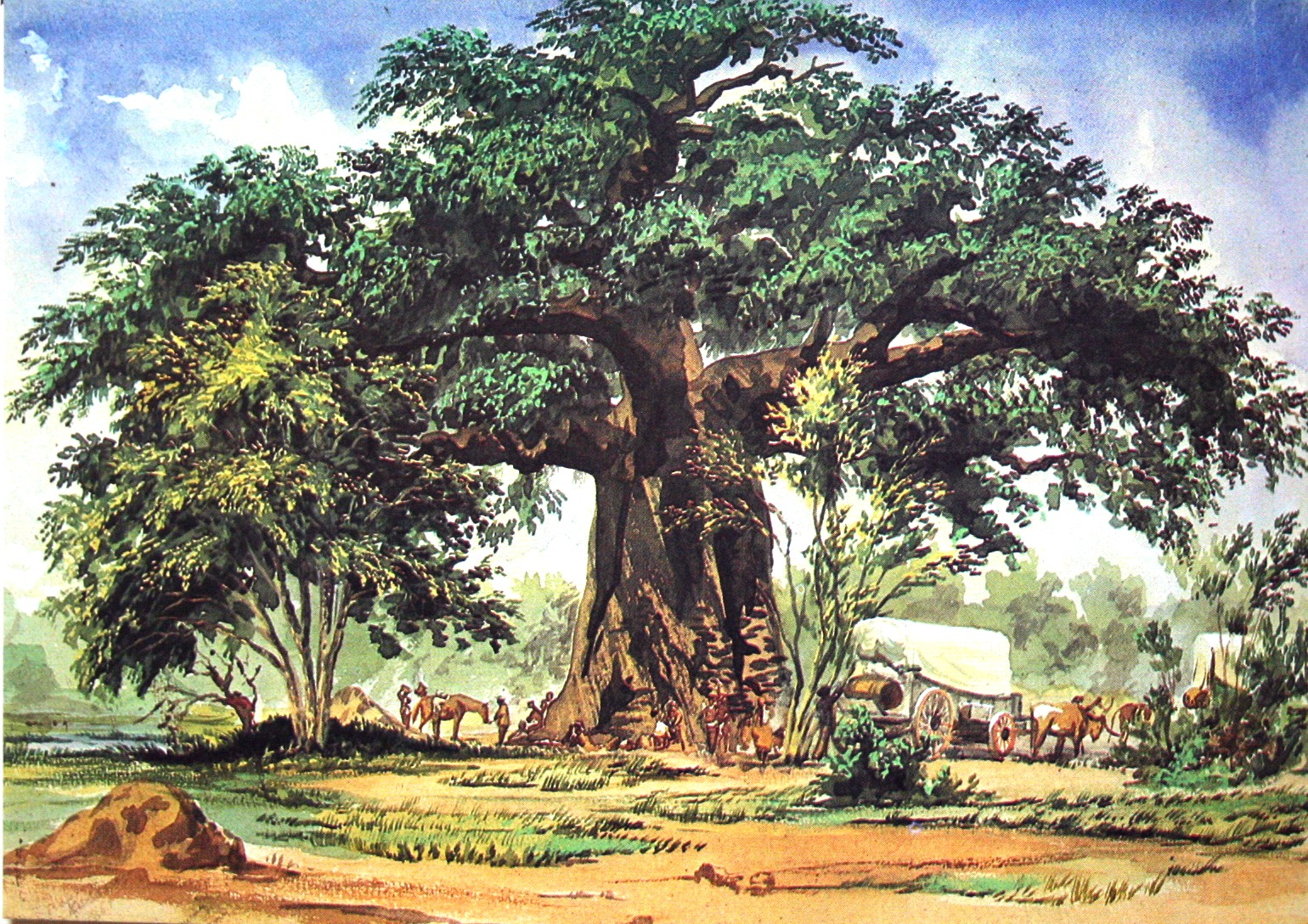
Still Standing: The Timeless Magic of Baines’ Baobabs draws us to a remote corner of Botswana in May 2025. The dry season has just begun, and we stand beside a grove of ancient baobab trees rising like sentinels from the edge of a glistening salt pan. Approaching them feels less like a game drive stop and more like stepping into a canvas — because these are the very trees painted by Thomas Baines in 1862. They are still standing, still magnificent, and still one of the most quietly powerful sights in all of southern Africa.
In the golden light of late afternoon the ancient baobab trees offer shade and a nursery for their offspring.


Quick Facts
Location: Nxai Pan National Park, Botswana
Famous for: Thomas Baines’ 1862 painting
Tree species: Adansonia digitata (African baobab)
Estimated age: 800 to over 1,000 years
Access: 4×4 only, self-drive or guided
Camping: One wilderness campsite nearby, no facilities
Best time to visit: May to October

What Are Baines’ Baobabs?
Baines’ Baobabs are a group of seven iconic baobab trees growing on a small island at the edge of Kudiakam Pan. Sometimes known as the Sleeping Sisters.They are named after the British explorer and artist Thomas Baines, who painted them in 1862 during an expedition with James Chapman. His artwork shows the exact same trees, standing just as they do now, almost eerily unchanged, even after over 160 years.
They have become a symbol of survival in the harsh landscape of northern Botswana and a must-visit for anyone exploring the Makgadikgadi region.
What We Saw
The trees themselves are vast and deeply grooved, their trunks gnarled from years of elephant tusks rubbing. As we approached on foot, a frankolin family scurried into a nearby thicket, chirruping indignantly at our presence.
Then, across the glimmering white crust of the pan, a lone elephant appeared, strolling with slow majesty across the salty soil. The juxtaposition was striking—this enormous animal dwarfed by an even older, more enduring presence.

Baobabs: More Than Just Trees
Under one of the trees, our guide showed us baobab fruit and seeds. They look like nougat, hard, oval, and tangy when chewed. Locals use the pulp to make a porridge-like drink that is packed with vitamin C, a breakfast staple for some.
Wild animals rely on the baobab too, for both food and moisture, especially during the dry season. Elephants strip its bark and eat the fruit, while baboons, monkeys, and antelope consume the fallen pods and seeds.


How Old Are They?
No one can say exactly. Baobabs are notoriously difficult to date, as they do not have traditional tree rings. Scientists use radiocarbon dating from the trunks. Some of these trees may be over 1,000 years old.
Our guide tells us to count the main trunks. We estimate one of them is 800 years old.
Their swollen, bottle-like shapes help them store water to survive droughts. And though their limbs look dead for most of the year, the first rains bring leaves and life, proof that they are still thriving.


Getting There: How to Visit
Location: Nxai Pan National Park, northeast Botswana
Nearest access points: Maun (about 2.5 to 3 hours by 4×4), or Gweta
Vehicle requirements: 4×4 essential, especially in the wet season
Park fees: Payable at the gate or through a tour operator
Permits: Required for camping – book through the Department of Wildlife or a trusted local operator
We travelled in a sturdy 4×4 with our guide, who expertly navigated the rough sandy tracks that lead into the park. After a bumpy and sandy ride through open plains and mopane scrub, the baobabs appeared on the horizon. Baobabs are always a strange and wonderful site, like nature’s own cathedral or trees in reverse.

Camping at Baines’ Baobabs
There is a designated wilderness campsite right near the trees. No water, no facilities—just you, the stars, and the wind sighing through ancient limbs.
We return one evening for sundowners, sitting quietly with gin and Amarula as the salt pan turned peach, then rose-gold, then blue-black. The silence was immense, no engines, no chatter, just the occasional bark of a jackal in the distance.
If you are camping, you will need to be entirely self-sufficient:
- Bring drinking water and food
- Never drive on the pans when wet—they become dangerously soft
- Leave no trace

Sundowners
When to Visit
Best time: May to October (dry season is better for travel and visibility)
Photography: Early morning and sunset offer the best light
Wildlife: Elephants, springbok, ostriches, and sometimes even lions or cheetahs may be seen en route
Final Thoughts
Baines’ Baobabs are not flashy. They do not roar or shimmer or boast. But their power is in their stillness, in being both present and timeless.
In a world that changes at dizzying speed, these trees offer a moment to pause. To breathe. To feel small in the best possible way.


Still Standing: The Timeless Magic of Baines’ Baobabs
- Examples of Baines Paintings
- A Baobab near the Bank of the Lue
- Botswana 1968 MNH, Baobab Trees, Painting by Thomas Baines, Arts
- Thomas Baines Baobab
The Secret Life of Botswana’s Termite Towers
Behind the Canvas: Secrets of a Botswana Mobile Safari
For more African Wee Wild Adventures
How to Walk to Victoria Falls Without a Tour: Everything You Need to Know